Hold the Gap: The Ten Seconds That Let Children Speak
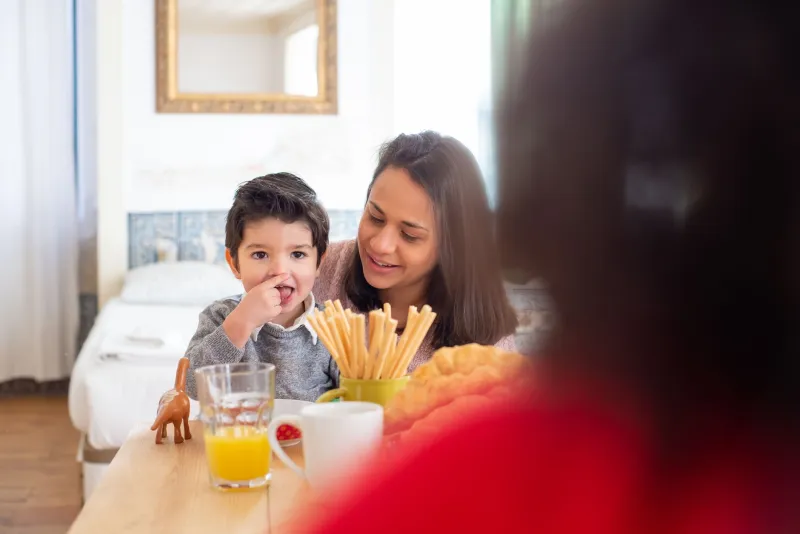
Picture the snack table. A four-year-old is holding a piece of apple and looking at the middle distance. You ask, 'What did you do at the weekend?' They blink. You wait. One second. Two. The silence stretches. So you help: 'Did you go to the park?' They nod. Conversation over. We have all done it. The urge to fill the gap is human, especially in a busy room where silence can feel like a problem to solve. But that gap is often where the thinking happens.
What wait time really means
Wait time is the pause between a question and the next thing an adult says. Not a dramatic countdown, not a technique to catch children out. Just a deliberate few seconds of quiet that gives a child time to process the words, find the idea, and get it out. For some children ten seconds is generous. For others it is barely enough. Children learning English as an additional language are translating, checking, choosing. Children with speech and language delays may need longer to plan the sounds. A child who is simply tired, or new, or thinking about a snail on the window needs the same courtesy. In practice, wait time is less about doing something extra and more about not doing something too soon.
The self-audit nobody enjoys
Try this for one session. Ask a colleague to tally three things: how often you answer your own question, how often you repeat or rephrase before a child has had a chance, and how often you fill the silence with 'come on' or 'have a think'. You do not need a clipboard and a spreadsheet. A scrap of paper will do. Most of us are surprised. We ask, 'What's this?' and then say, 'It's a tractor' before the child has looked properly. We ask, 'Who wants to tell me about...' and then rescue the pause with another question. This is not a telling-off. It is a noticing. You cannot change a habit you have not seen.
Ten seconds feels enormous
In ordinary adult chat, gaps are tiny. We jump in fast. Ten seconds feels rude, awkward, like the conversation has died. In a nursery, it can feel worse because there are twelve other children, a snack to pour, and a planner in your head. But a pause is not lost time. It is the bit where the child does the work. If we fill every gap, we teach children that someone else will finish their sentence. If we hold the gap, we teach them that their words are worth waiting for. That is a big message delivered by doing very little.
Room by room
Group time is the hardest place to wait. Circle time can become a quiz with a queue of eager hands and one adult firing questions like a tennis machine. Try one open question, then stop. 'I wonder what happened next in the story.' Count to ten in your head. Look at the children, not at the next question. If nobody speaks, offer a visual or a choice, then wait again. You are not abandoning the group; you are slowing the pace enough for thinking.
Snack chat is easier to fix than it looks. Instead of interviewing every child, sit with one small group and comment rather than question. 'You've got grapes today.' Then wait. A child might say, 'My mum got them.' That is the opening. Do not pounce with three follow-ups. Let the conversation breathe. If a child is quiet, stay nearby. Silence at snack is not a failure.
Outside, wait time looks like standing still. You notice a child at the water tray, hovering. You want to say, 'Are you making a river?' Try waiting. They may tell you. They may not. Either way, you have given them space to start.
In the book corner, pause after the page turn. Let the picture do some work. In care routines, narrate less. 'Up we go' is useful; a running commentary is not always needed. A quiet nappy change with a smile and a pause can be a conversation too.
Phrase swaps that hand it back
These are small, free, and do not need a planning meeting.
Instead of 'What colour is it?' try 'Tell me about it.' Then wait.
Instead of 'Can you say tractor?' try 'I wonder what this is.' Then wait.
Instead of repeating the question, say 'I'm listening.'
Instead of 'Come on, think,' try 'Take your time.'
Instead of answering for a child, say 'What do you think?'
Instead of 'Good talking!' try 'You told me about the dog.' That names what they did rather than judging the performance.
And when a child gives you one word, resist the urge to stretch it into a sentence for them. You can model the sentence later, in your reply, without asking them to repeat it.
At home, same rule
Parents and carers can use the same pause at bath time, in the car, or over tea. It does not require a special activity. Ask less, wait more. If your child is quiet, do not turn the silence into a test. 'Can you tell me?' is fine. 'Why aren't you answering?' is not. Some children need a choice: 'Was it the slide or the swings?' Some need a picture or a sign. Wait time is a courtesy, not a hurdle.
When waiting is not the answer
Wait time is not a cure-all. If a child rarely responds, keep noticing. Talk to your SENCO, check hearing, use visual supports, and follow speech and language therapy advice. For children with English as an additional language, waiting is powerful, but so is home-language support and a key person who knows the family. Never use silence as a way to withhold help. The aim is not to make a child perform. It is to make sure we have not spoken over them.
Ten seconds is not long. It is long enough to stop answering our own questions. Long enough to let a child find a word. Long enough to notice that the quiet child at the snack table was about to speak. In a room full of noise, the most useful thing you can do might be to say nothing, warmly, and wait.