Wriggle Room: Why Group Time Works Better When Nobody Has to Sit Still
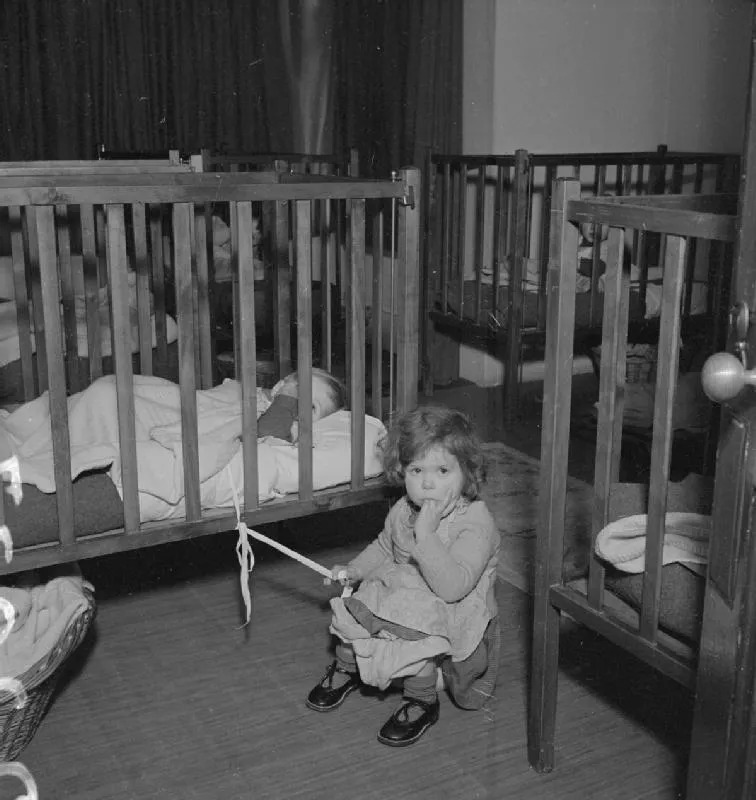
Photo: Ministry of Information Photo Division Photographer, Public domain, via Wikimedia Commons
Picture the scene: it’s 9.10am, the carpet is out, and twenty-two under-fives are being encouraged into “good sitting”. Legs crossed. Hands in laps. Eyes on the adult. For the first two minutes it can look lovely. By minute six, someone has a shoe off, two children are lying down, and a practitioner is quietly negotiating with a three-year-old who has decided the book corner is a better idea.
None of that means group time is bad. It means we might be asking too much of it — and of the children.
The trouble with ‘good sitting’
“Good sitting” is not a learning objective. It is a behaviour management phrase. It is not in the EYFS, it is not what Ofsted is looking for, and it is not a reliable sign that children are listening, thinking or joining in.
For under-fives, learning is rarely a still, silent activity. It is active, social, sensory and often noisy. A child who is kneeling, fiddling with a sleeve or lying on their tummy may be taking in far more than the child who has mastered the cross-legged pose while mentally drifting towards snack time.
That does not mean we should abandon gathering together. Shared group moments can build connection, routine, language and a sense of belonging. But when a session is mostly about keeping bottoms on the carpet, the learning tends to slide out of the room.
What group time is actually for
Before changing anything, it helps to ask what the group moment is doing. Is it for stories and songs? For noticing the weather? For talking about a shared experience? For helping children learn each other’s names? For settling into the day?
Those are all worthwhile. But they rarely need a long, formal carpet session. Many can happen in five minutes, with movement built in, or in smaller key-person groups where children are more likely to speak and less likely to disappear into the crowd.
In 2026, with mixed-age rooms, rising levels of need and packed timetables, the temptation to use group time as a way of containing the room is understandable. The risk is that containment quietly becomes the point.
Small shifts that make a difference
Shortening a session is the simplest place to start. A five-minute song and story for toddlers can do more than fifteen minutes of sitting and shushing. For older children, ten minutes with a clear purpose and an active role is often plenty.
Movement matters too. Children can stand, kneel, sit on a chair or lie on their tummy. They can pass a beanbag, copy actions, point to the window, or take a prop back to their place. Giving a child a small fidget or a picture card is not a reward for poor listening; it is a reasonable adjustment that helps them stay available for learning.
Visuals help everyone. A simple sequence — song, story, goodbye — reduces the need for repeated instructions. A visual timetable or a couple of picture symbols can make group time more predictable without making it rigid.
And choice is powerful. A child who knows they can move to the nearby puzzle table if group time feels too much is less likely to escalate, and more likely to return later. That is not a free-for-all; it is a considered environment.
A five-question audit for your setting
If you want to rethink group time without throwing it out, try this simple audit with your team. It works for a whole-room session, a key-person group or a storytime routine.
- Who is this session actually for? Is it for the children’s learning and connection, or mainly for crowd control and tidying up? Be honest.
- How long is it, really? Time it from the first call to the last child leaving. Compare that with the ages and needs of the children in front of you.
- What are children doing with their bodies and voices? Are they passive for most of it, or are there moments to move, choose, sing, sign, point or talk to a friend?
- Who is being corrected most often? If the same children are repeatedly told to sit still, the session may be too long, too narrow or poorly matched to their needs.
- Could this happen somewhere else, or in a smaller group? A story outdoors, a song in two groups, or a conversation at snack time may achieve more than a large carpet gathering.
You do not need to change everything at once. Pick one question, try one adjustment for a week, and notice what happens. Sometimes two minutes less and a bit more movement changes the whole feel of the room.
The point is connection, not compliance
Group time can be a lovely part of nursery life. It can be where children learn a new song, hear a story, practise waiting, notice each other and feel part of something. But it works best when the aim is genuine connection rather than perfect stillness.
So keep the songs, keep the stories, keep the shared routines. Just make room for wriggles. A child who is allowed to be comfortable is a child who is far more likely to be listening — and that is a much better measure than good sitting.