Read It Where They Are: Letting Stories Travel Through the Nursery Day
The book corner is a lovely thing. Cushions, a low shelf, a few favourites face out. But watch a busy nursery room for an hour and you’ll notice something: the children who most need stories are often the least likely to choose that corner. They’re at the sand tray. They’re pushing a trolley. They’re standing at the snack table with one shoe off. A quiet book area can be a haven — it just can’t be the only door into reading.
This isn’t an argument against quiet spaces. It’s an argument for more doors.
Quiet is one route in, not the entrance exam
Some children do seek out a soft seat and a pile of books. That’s worth protecting. But in many UK settings, the book corner quietly becomes a test of a certain kind of child: the one who can settle, who likes sitting still, who already knows how to handle a book. The wrigglers, the movers, the children still learning English, the ones who arrive full of big feelings — they often get the message that stories are for later, or for other people.
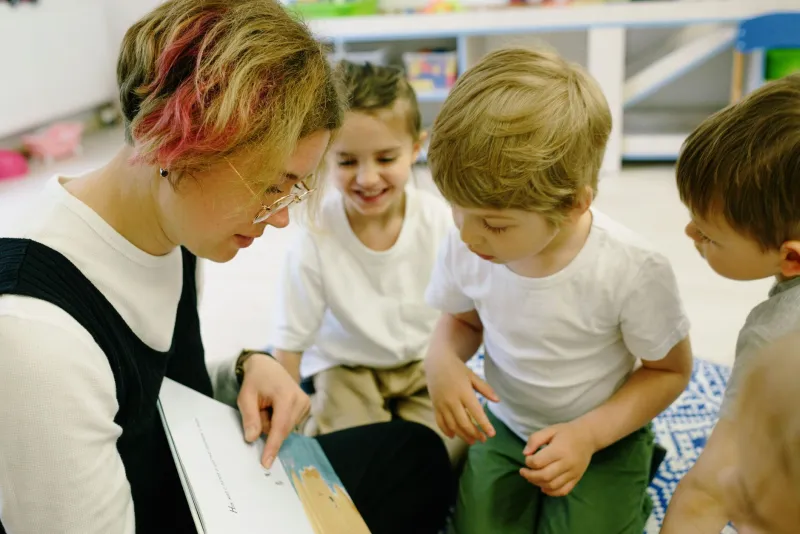
Reading aloud amid noise isn’t a lesser version of reading aloud. Shared reading is about connection, vocabulary, rhythm and joy. It doesn’t require silence. It requires an adult who is genuinely interested and a child who feels welcome to come and go.
Put a book where the children already are
One of the simplest shifts is to stop treating books as a destination and start treating them as part of the furniture. Not decoration — usable stuff.
A basket of board books next to the construction area, with diggers and building site stories. A few recipe cards and food magazines in the mud kitchen. Catalogues and menus in the home corner. Animal books beside the small-world farm. A weather book near the window. These aren’t gimmicks. They’re invitations. They let a child who would never choose the book corner pick up a book because it belongs to what they’re already doing.
Expect some wear and tear. A book that gets chewed, dropped and carried around is doing its job. Save the pristine hardbacks for the quiet shelf.
Snack time can carry a story
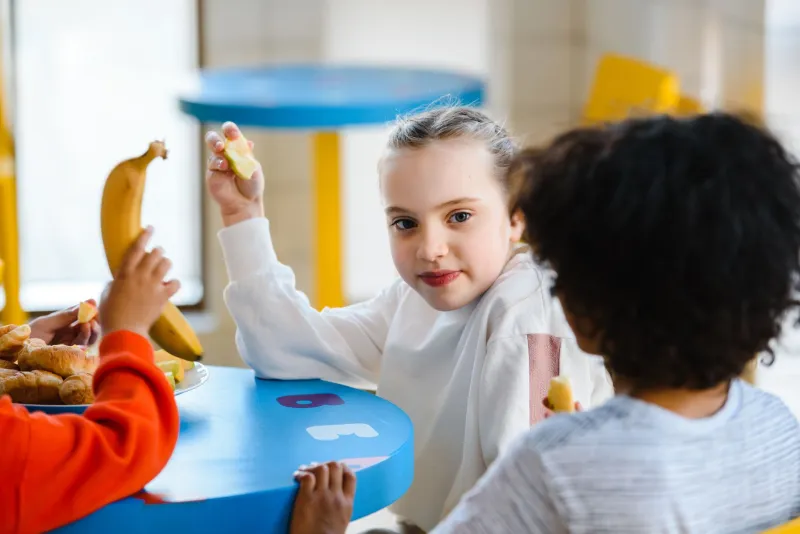
Snack time is one of the most underused reading moments in a nursery day. Children are sitting, hands are busy, and there’s a natural pause. You don’t need a full story session. One short picture book, read slowly, with room for children to look up and look away, can work beautifully.
Keep it low-pressure. ‘You can listen while you crunch.’ Let children join in with a repeated refrain if they want to. Use a prop or two. If the group loses interest, stop. The aim is a pleasant association, not a compliance exercise.
Wriggly listeners are still listeners
A child who is rolling on the floor may still be taking in every word. A child who is fiddling with a zip may be listening more easily than one who is sitting cross-legged with a frozen smile. In the early years, movement and attention are not opposites. Many children need to move to think.
So build in movement: action rhymes, sound effects, standing up to roar like a lion, pointing at pictures from across the room. Offer a fidget toy or a cushion to hold. Let children stand at the edge of the group. The story doesn’t have to wait for stillness.
Take stories outside
Outdoor provision is often where the most engaged play happens — and it’s a natural home for stories. A weatherproof book basket by the door. Chalk story maps on the patio. Story stones in the mud kitchen. A clipboard and pencils for children to make their own signs and labels.
You can also let a familiar story spill into the garden. Read ‘We’re Going on a Bear Hunt’ and then go on a bear hunt. Read a book about minibeasts and take it outside to look under logs. The book becomes a tool for the play, not a separate activity.
Make room for home languages
For multilingual families, books can be a bridge or a barrier. If every book in the setting is in English, a child who is still learning English may avoid them. Include dual-language texts and books in children’s home languages. Invite families to record a story on a tablet or phone. Make simple photo books with family names and familiar objects. Keep these books in the main areas, not in a separate ‘diversity’ box — they belong in the everyday mix.
Read like you’re talking, not performing
Dialogic reading — the back-and-forth style where adults ask open questions and follow the child’s lead — is well evidenced and easy to do. But it can tip into a quiz if we’re not careful. ‘What’s that? What colour is it? How many?’ turns a story into an assessment.
Try noticing instead. ‘Look at that dog’s face.’ ‘I wonder why she’s hiding.’ ‘That reminds me of when we made pancakes.’ Pause. Let the child fill the gap or not. Repeat favourite books until the child knows them inside out — repetition builds vocabulary and confidence.
The adult’s job is invitation, not enforcement
If a child walks away from a story, let them go. Leave the book open on the table. Read to yourself where they can see you. Children are drawn to adults who are genuinely enjoying a book. Modelling pleasure is more powerful than directing attendance.
And remember that reading isn’t only picture books. It’s signs, labels, recipes, catalogues, instructions, name cards. A child reading a recipe in the mud kitchen is reading. A child spotting their name on a peg is reading. A child retelling a story with small-world figures is reading.
Keep the corner, widen the door
The book corner can stay. Make it cosy, keep it stocked, protect it. But don’t let it be the only place a story lives. Put books in hands, in play, in the garden, at the snack table. Read aloud when the room is busy. Let stories be part of the noise.
Because the child who never chooses the quiet corner may be the one who most needs to hear a story today.