The Shared Bowl: Why Snack Time Belongs at the Table
Photo: Collins, Tudor Washington, 1898-1970, photographer, CC BY 4.0, via Wikimedia Commons
Snack time can easily become a pit stop. A trolley rolls in, plates are handed out, mouths are filled, hands are wiped, and everyone gets back to the important business of playing. It is efficient, familiar and — on a busy morning — completely understandable.
But snack time is also one of the few points in a nursery day when children and adults naturally end up at the same level, doing the same thing. That makes it a quietly powerful bit of practice. Family-style snack time is not about recreating a perfect Sunday lunch in the toddler room. It is about letting children sit together, pass things, choose amounts and talk, with an adult close by rather than hovering over a trolley.
The trolley isn’t the villain
Adult-served snacks have real advantages. They are quick, controlled and easy to manage when you are short-staffed or working with a room full of very young children. Nobody needs to feel guilty about a trolley. The question is whether it has become the only way snack happens, even when the room and the routine could cope with something a little more social.
In many settings, the shift starts with a simple observation: children are more interested in what everyone else is doing than in the snack itself. They watch who gets which cup. They notice who is sitting where. They want to pour, choose, reach and help. Family-style snack time taps into that interest instead of tidying it away.
What family-style actually means
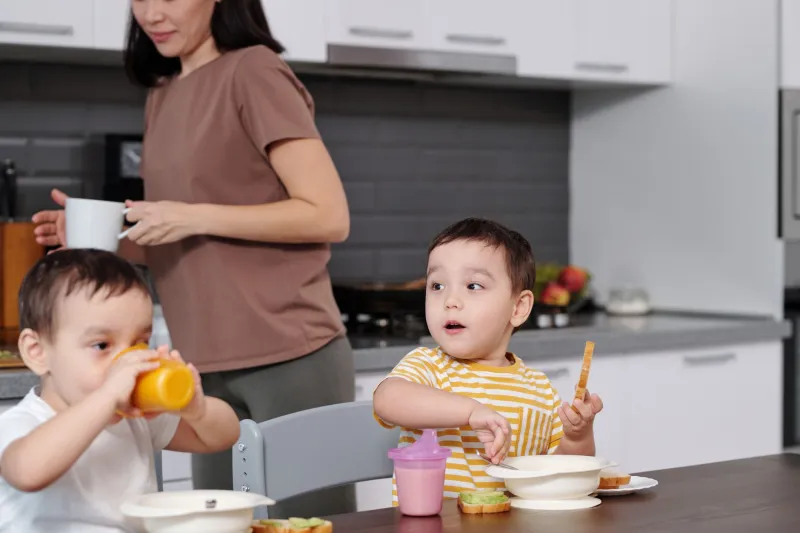
It does not mean a free-for-all. In practice, family-style snack usually means children sit at a table — or in small groups on a mat — with the food and drink placed within reach in manageable amounts. An adult sits with them, models the language and helps where needed. Children serve themselves, or choose between two options, and clear their own plate or cup when they are finished.
The details will look different in a baby room, a toddler room and a preschool room. With under-twos, it might be a shared bowl of soft fruit and an adult sitting alongside. With older children, it might be a small jug, a serving spoon and a job chart that rotates each day. The principle stays the same: snack is something we do together, not something that is done to children.
Independence is built in small reaches
Self-serving is not just a cute photo opportunity. It asks children to judge how much they want, coordinate a spoon, wait for a turn and ask for help. Those are real skills, and they take practice. A child who tips half a jug of milk on the first attempt has not failed. They have learned something about weight, angle and the value of a steady hand.
Start with low-risk items: apple slices, breadsticks, cucumber, small jugs with handles, a bowl of cereal that is easy to scoop. Keep portions small so the risk of a huge spill stays manageable. Let children add more rather than piling a plate high at the start. And build in a clear routine for what happens when something goes wrong, so a spill is just a spill rather than a small crisis.
Allergies need a plan, not a panic
Family-style snack can make allergy management feel more complicated because food is shared and children are reaching. It does not have to be unsafe, but it does need to be thought through properly.
Keep an up-to-date allergy and dietary needs list where staff can see it, and make sure everyone working in the room knows the plan, not just the person leading snack. Use separate serving utensils for known allergens, or avoid shared bowls for those items altogether. Individual placemats or named mats can help children learn which space is theirs. If a child has a prescribed adrenaline auto-injector, the setting’s policy should be clear about where it is stored and who knows how to use it.
The goal is not to wrap snack time in fear. It is to make the routine predictable enough that everyone — children and adults — knows how to keep it safe.
Ratios, spills and the reality of small rooms
Family-style snack does not have to mean every child sits down at once. In a small setting, staggered groups often work better. Six children at a table with one adult can feel calmer than twelve children waiting for a trolley. The adult is sitting, not serving from a height, which usually makes conversation easier and supervision more natural.
Spills will happen. Keep a damp cloth, a small dustpan and a spare jug within reach. Teach children where the cloth lives and let them help wipe up. A spill that is met with ‘Oops, let’s get the cloth’ teaches more than a spill that is met with a sigh. If the floor gets slippery, deal with it straight away and keep the area clear.
Hygiene matters, but it can be built into the routine rather than bolted on. Children wash hands before snack. Adults wash hands before handling food. Surfaces are cleaned before and after. Serving utensils are used rather than fingers, and children are shown how. It is not glamorous, but it is doable.
Small-setting swaps that stick
You do not need a complete overhaul. Try one change for a fortnight and see how it feels.
- Swap the trolley for a low table with two or three shared bowls.
- Put the cups and jugs on the table instead of handing them out.
- Sit down with the children for the first five minutes rather than standing over the table.
- Add one self-serve item that is easy to scoop or pour.
- Let children scrape their own plates or put their cup in a basin.
- Use the same simple phrase each day: ‘Help yourself. Take what you need.’
Keep the routine predictable. Children relax when they know what is coming, and staff relax when they know the allergy plan, the spill plan and the handwashing plan are not being invented on the hoof.
The conversation is the point
Family-style snack is not really about the food. It is about the twenty minutes when everyone slows down enough to notice each other. Children learn to ask, wait, offer and refuse. They hear adults using words for ‘more’, ‘enough’ and ‘would you like some?’ They practise the everyday social glue that makes a room feel like a community.
In a busy nursery day, that is not a luxury. It is part of the curriculum — and it usually smells a lot better than a trolley.